The Finance Notes is an independent financial comparison platform. We may earn a commission when you click through.
Car Loans Compared: Rates, Access, and Dealer Tradeoffs
Compare 10 car-finance providers by advertised APR, dealer access, credit requirements, refinancing tools, and total borrowing tradeoffs.
Quick Picks
Best overall: LightStream Auto Loans.
Best budget: myAutoloan.
Best for refinancing: Autopay Auto Loans.
Car financing is not just a rate contest. Dealer access, credit requirements, loan fees, funding speed, and the freedom to buy from a private seller can matter just as much. The advertised APR is a starting point, not a promise.
Rates and terms shown are representative. Your actual rate depends on your credit profile and circumstances. This is not financial advice — always read the lender's terms before applying.
Low-Rate Choices With More Borrower Control
The lowest advertised rates in this group range from 3.99% to 6.49%, but the cheapest number often comes with conditions. Check the credit profile required, whether the lender permits dealer financing, and whether the rate applies to a purchase or only refinancing.
LightStream Auto Loans: Competitive Financing Options
LightStream earns the top spot for borrowers with strong credit who want to shop like cash buyers. According to the lender's website, rates start at 6.49% APR with AutoPay, and the loan has no origination fee or prepayment penalty. Funding goes directly to the borrower's account, which can help with dealer negotiation and also works for private-party purchases. The lender does not restrict the vehicle's age or mileage, a useful detail if a newer used car is not in the budget. The downside is meaningful: the lowest rate requires excellent credit, the maximum APR can reach 25.39%, and there is no co-signer option. A $25,000 loan at 6.49% over 60 months would cost about $489 per month before any taxes or registration costs; a higher approved rate changes that payment quickly. LightStream also cannot be used for dealer financing, so buyers who want the dealership to handle everything should look at Chase, Ally, or a marketplace instead. Best for a borrower with good-to-excellent credit, a private seller or flexible dealer, and enough confidence to negotiate the vehicle price separately from the loan.

LightStream Auto Loans: Competitive Financing Options
APR: 6.49%–25.39%
myAutoloan Auto Loan
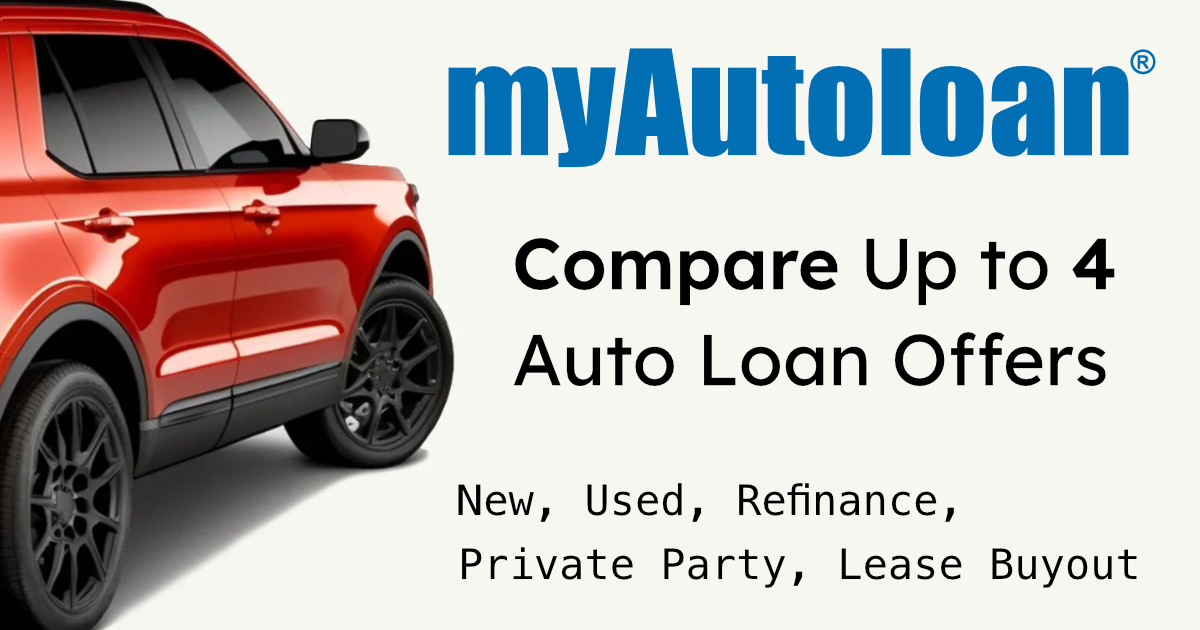
myAutoloan advertises the lowest starting figure in this ranking: refinancing rates as low as 3.99%, according to its website. The platform says applicants can receive up to four offers in minutes and can compare new-car, used-car, refinance, private-party, and lease-buyout financing. That breadth is more useful than a single headline APR because the right loan depends on the transaction. The important qualification is that these are pre-qualified offers from participating lenders, not one guaranteed rate from myAutoloan itself. The platform's marketplace structure means terms, fees, vehicle rules, and credit standards can vary after an application. A 3.99% refinance rate may look compelling, but extending the term can increase total interest even when the monthly payment falls. Compare the new payment and the remaining balance, not just the rate. This pick makes the most sense for a car owner with an existing loan, enough equity, and time to review several lender offers. Buyers with weak credit should not assume the advertised rate applies; the site itself presents it as an as-low-as figure. Best for shoppers who want multiple offers, including private-party or lease-buyout financing, and who are willing to read each participating lender's terms.
myAutoloan Auto Loan
APR: 3.99%–24.99%
myAutoloan has the sharper headline rate, but LightStream gives a clearer fee advantage and more control over the purchase. The next pick sits between them: a marketplace built specifically around refinancing, with a lower stated floor than LightStream but less certainty about which lender will ultimately make the offer.
Autopay Auto Loans
Autopay is the practical middle ground for borrowers who want to refinance without contacting lenders one by one. Its website describes a network model with rates from 4.67% APR and support for new-car purchases, used cars, and lease buyouts. The application is online and decisions are positioned as quick, but Autopay is an intermediary rather than the direct lender. That distinction matters: the final lender controls the APR, fees, approval decision, vehicle rules, and servicing experience. The stated minimum credit score of 580 makes the platform more accessible than LightStream, although a score near that floor will not normally produce the advertised rate. The maximum APR can reach 21.99%, so compare the full payment schedule rather than assuming a refinance automatically saves money. A lower monthly payment may simply reflect a longer term. According to the provider's website, the platform handles both refinancing and purchase financing, giving it more range than a refinance-only service. Best for a car owner with a 580-plus score who wants to test refinance offers across several lenders and can verify the final lender's disclosures before accepting.

Autopay Auto Loans
APR: 4.67%–21.99%
Bank and Credit-Union Financing
A bank or credit union can be easier to understand than a marketplace: one institution sets the terms, manages the account, and handles the payment relationship. The tradeoff is that the lowest rate may require strong credit, membership, an existing account, or a particular dealer channel.
DCU Auto Loan
DCU is the rate-focused credit-union pick, with advertised auto-loan rates from 5.24% APR and terms as long as 84 months. The credit union states that membership is available to anyone without an employer or military restriction, which removes a common barrier found at other credit unions. There is no application fee, but the long-term flexibility deserves a warning: an 84-month loan can reduce the payment while keeping the borrower in debt for seven years and increasing total interest. A $30,000 loan spread over 84 months may fit a tighter budget, yet the vehicle could lose value faster than the balance falls. DCU's best rates still require excellent credit, and its physical branch presence is limited, especially outside the Northeast. That makes online account management and document handling more important than branch convenience. Compared with Chase or Wells Fargo, DCU may appeal to a borrower willing to join a credit union for pricing rather than banking integration. Best for a US buyer with strong credit who wants a credit-union rate, needs a longer term, and is comfortable managing the loan primarily online.

DCU Auto Loan
APR: 5.24%–18.0%
Chase Auto Finance
Chase Auto Finance gives existing Chase customers a clean administrative experience, with online pre-qualification, no application fee, and a broad dealer network. The lender advertises rates from 5.49% APR, according to the Chase auto-finance page, and supports payment links to Chase checking and savings accounts. That convenience is real, but it should not replace rate shopping. The listed starting rate is higher than DCU's 5.24% floor and LightStream's 6.49% is not directly comparable because each lender uses its own credit tiers and loan conditions. Chase also has limited term flexibility, while DCU advertises terms up to 84 months. The strongest case for Chase is not a special financing feature; it is the combination of a national bank, dealer access, and a familiar payment setup. A borrower who already banks with Chase may value fewer accounts to manage, but should still request an outside quote before visiting the dealer. Dealer financing can be convenient, yet the vehicle price and loan terms should be negotiated separately. Best for a Chase customer with strong credit who wants dealer-compatible financing and easy account management, but is willing to compare the offer against a credit union.

Chase Auto Finance
APR: 5.49%–17.99%
Wells Fargo Auto Loans
Wells Fargo's advertised starting APR is 5.49%, matching Chase in the supplied data, and eligible checking customers may receive a 0.25% relationship discount. That discount sounds small, but on a $30,000, 60-month loan it can reduce the payment by roughly $3 to $4 per month and trim total interest by around $200, depending on the approved rate and exact terms. The benefit is therefore useful, not transformative. The lender also supports refinancing and has national-bank reach, but the listed minimums are higher than those at some credit unions, and the supplied notes flag recent satisfaction concerns. Existing Wells Fargo customers should calculate the discount against the full APR and fees rather than treating the relationship benefit as automatic savings. Compared with Chase, Wells Fargo offers a similar starting rate but a clearer account-based discount; compared with DCU, it may be less attractive for borrowers who qualify for the credit union's lower floor. Best for an existing Wells Fargo customer with strong credit who can qualify for the relationship discount and wants a national lender with refinancing available.

Wells Fargo Auto Loans
APR: 5.49%–19.99%
Credit-union pricing is strongest on paper, while the major banks win on dealer reach and account convenience. That distinction matters at the dealership: a buyer who wants a preapproved check can lean toward LightStream or DCU, while someone who wants the dealer to coordinate financing may prefer Chase or Ally.
Dealer-First Buying and One-Stop Car Shopping
Convenience becomes the main feature in this group. These providers connect financing to a dealership or vehicle marketplace, which can reduce paperwork but also narrows where you can buy and how independently you can negotiate.
Capital One Auto Finance
Capital One Auto Finance is less transparent in the supplied material than the lenders above, but its shopping flow is easy to understand: search new or used vehicles, enter a ZIP code, and request pre-qualification. The site separates car shopping from the financing application, which can help a buyer set a vehicle budget before stepping into a dealership. The supplied rate figure is 4.91%, but no accompanying APR range, fee schedule, credit requirement, or term details are provided here, so that number should not be treated as a complete offer. This is the key weakness: a low displayed figure without the conditions behind it tells you little about the total cost. Capital One's vehicle-search model may suit a buyer who wants to compare inventory and financing in the same online journey, while LightStream is better for someone buying from a private seller or negotiating as a cash buyer. Request the full offer, including APR, term, amount financed, and any dealer restrictions, before comparing it with DCU or Chase. Best for a shopper who wants vehicle search and pre-qualification in one place and will verify the final terms rather than relying on the headline rate.

Capital One Auto Finance
APR: 4.91%–14.99%
Ally Auto Finance
Ally is built around dealership financing rather than direct-to-borrower cash funding. The provider describes itself as a large digital auto lender, with financing available at most dealerships and refinancing also offered. Its listed starting APR is 5.99%, higher than Chase, Wells Fargo, and DCU in the supplied comparison, and the lender is available only through dealers. That restriction is the deciding factor. A buyer who has already chosen a dealer may appreciate the integrated process, but someone comparing private-party vehicles or seeking leverage in price negotiations should look elsewhere. Ally's online account tools include payment management, alerts, and access to a FICO Score, which can make ongoing account administration easier. Those tools do not offset a higher rate if another lender offers materially better terms. Ask the dealer for the vehicle's out-the-door price before discussing monthly payment, then compare Ally's offer with an outside preapproval. Best for a dealership buyer who wants an auto-focused lender, prefers dealer-arranged financing, and values online account tools more than the lowest advertised APR.

Ally Auto Finance
APR: 5.99%–22.99%
CarMax Auto Finance
CarMax combines the vehicle and financing transaction, which is convenient for used-car shoppers who want fewer moving parts. Its page reports that more than 97% of visitors get pre-qualified, but pre-qualification is not the same as approval or a guaranteed rate. The supplied notes also say rates start higher than credit-union pricing, and financing is limited to CarMax vehicles. The 30-day money-back guarantee applies to the vehicle purchase experience, not necessarily to every financing cost, so read the return and loan terms separately. Compared with Carvana, CarMax offers a more retailer-centered process; compared with DCU or LightStream, it gives up lender choice and private-party flexibility. The right comparison is the complete out-the-door price plus APR, not the monthly payment shown in the retailer's interface. A retailer loan can be reasonable when the vehicle price is competitive and the financing terms are close to an outside quote. Best for a used-car buyer who values one-location shopping, wants pre-qualification before selecting a vehicle, and is prepared to compare CarMax's APR with a bank or credit union.

CarMax Auto Finance
APR: 5.49%–27.99%
Retailer financing saves time, but the convenience has a boundary: CarMax limits the vehicle choice to its inventory, Ally requires a dealer, and Capital One's rate details need more verification. The final group is for shoppers who want a largely digital car-buying process and are willing to accept a higher stated rate in exchange for speed or access.
Digital Retailers and Access-Focused Picks
Digital retailers can shorten the path from vehicle search to financing, but the quoted payment may assume a long term. Carvana's sample payment, for example, uses 75 months, so compare total interest and vehicle price before judging affordability.
Carvana Auto Finance
Carvana's financing page emphasizes pre-qualification in minutes with no hard credit hit, and it says the platform welcomes all credit types. The sample shown in the supplied page is $395 per month at 6.99% APR over 75 months with $0 down for a well-qualified buyer. That example is useful precisely because it exposes a common financing trap: a manageable monthly payment can hide a long repayment period. At 6.99% over 75 months, a $25,000 balance would produce a payment near the displayed range but substantially more interest than a 60-month schedule. The sample also applies to a well-qualified buyer, so borrowers rebuilding credit should expect different terms. Carvana's integrated online purchase process may appeal to someone who wants to complete the transaction remotely, but the vehicle selection and financing are tied to the retailer's inventory. Compared with CarMax, Carvana presents a more digital-first experience; compared with LightStream, it offers less freedom to shop outside the retailer. Best for a buyer who prioritizes online pre-qualification, needs a retailer-based process, and will compare total repayment rather than focusing only on the monthly figure.

Carvana Auto Finance
APR: 6.9%–27.9%
Comparison Table
Use the table as a screening tool, then open the lender's terms. Advertised starting APRs are not interchangeable: some may apply only to refinancing, some require AutoPay or excellent credit, and some are marketplace or retailer examples.
| Provider | Advertised starting APR | Primary use | Key advantage | Main limitation |
|---|---|---|---|---|
| LightStream Auto Loans | 6.49% | Purchase | No origination or prepayment fees; funds go to borrower | Excellent credit for lowest rates; no dealer financing |
| Capital One Auto Finance | 4.91% listed | Vehicle shopping and financing | Search inventory and pre-qualify online | Full rate and fee details not supplied |
| Autopay Auto Loans | 4.67% | Refinance and purchase | Multiple lender offers; minimum score listed at 580 | Intermediary; terms vary by lender |
| Chase Auto Finance | 5.49% | Dealer financing | National dealer network and no application fee | Strong credit needed for best pricing |
| myAutoloan | 3.99% refinance | Refinance, purchase, private party | Up to four participating-lender offers | Advertised rate is an as-low-as marketplace figure |
| Ally Auto Finance | 5.99% | Dealer financing and refinance | Available through most dealerships | Dealer-only financing; higher starting APR |
| Carvana Auto Finance | 6.99% sample APR | Carvana vehicle purchase | Pre-qualification without a hard credit hit | Sample uses 75 months and applies to well-qualified buyers |
| CarMax Auto Finance | Not supplied | CarMax used vehicles | One-stop shopping and reported 97%+ pre-qualification | CarMax inventory only; rates start higher than credit unions |
| DCU Auto Loan | 5.24% | Purchase and refinance | Open membership and terms up to 84 months | Best rates require excellent credit; few branches |
| Wells Fargo Auto Loans | 5.49% | Purchase and refinance | 0.25% relationship discount for eligible checking customers | Higher minimums than some credit unions |
Source checks: review the LightStream auto-loan page, the Autopay financing page, and the DCU auto-loan page before applying. Chase, Wells Fargo, Ally, Carvana, CarMax, Capital One, and myAutoloan should also be checked directly for current eligibility, APR ranges, fees, vehicle restrictions, and term rules.
Final Recommendation
Choose LightStream if you have strong credit, want no lender fees, and need the freedom to buy from a private seller or negotiate as a cash buyer. Choose myAutoloan or Autopay for refinance shopping, DCU for credit-union pricing, and Carvana or CarMax only when the retailer's convenience outweighs the limits on vehicle choice and financing control.
Before signing, compare at least three written offers, calculate the total interest, and keep the vehicle price separate from the monthly payment.